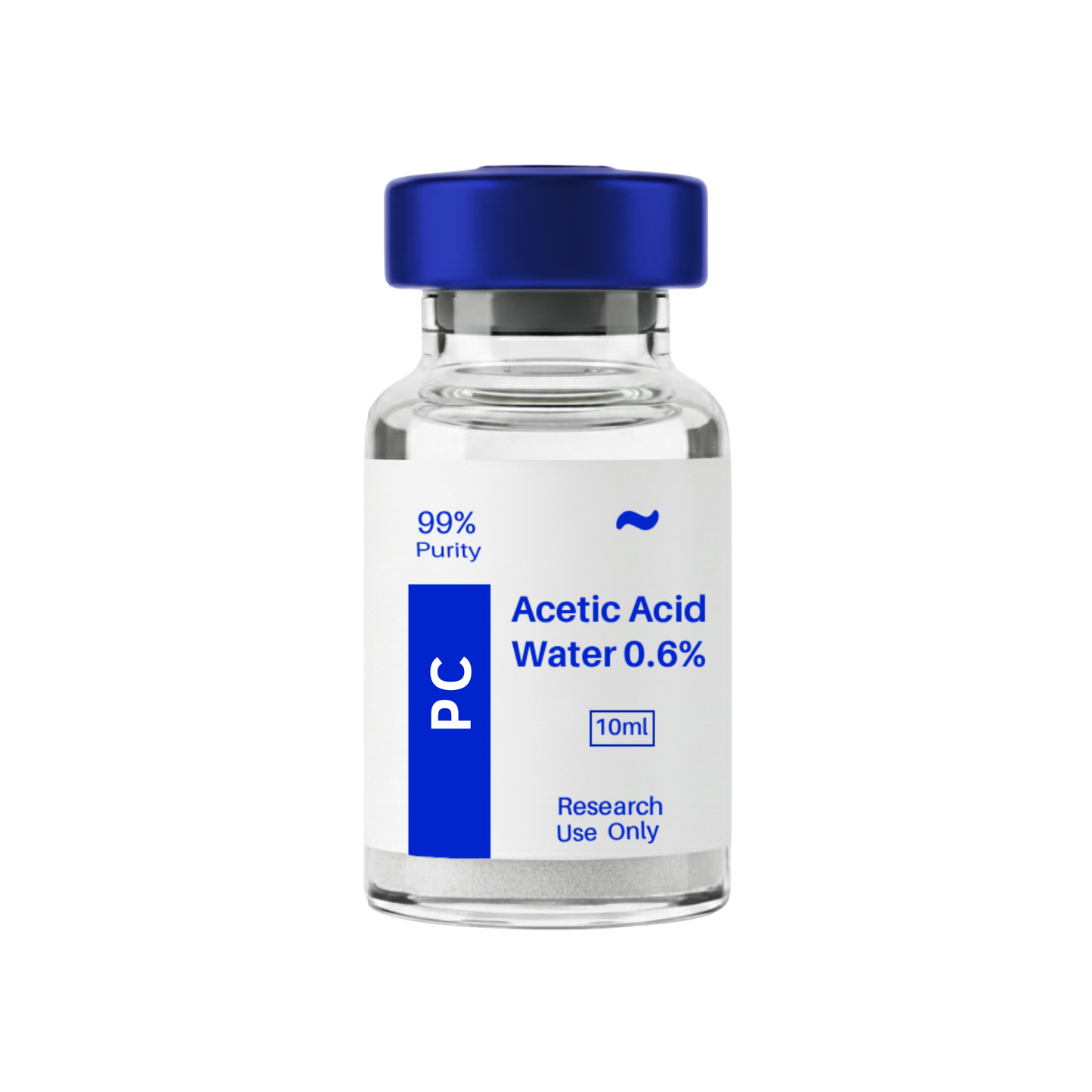
Standard Laboratory Practice: The 0.6% Acetic Acid Solution
1. Introduction: The Cornerstone of Protein Biochemistry
Acetic acid, chemically known as ethanoic acid (CH₃COOH), has held a foundational role in the field of protein biochemistry since the early days of protein isolation and characterization. Its utility stems from its unique properties as a weak organic acid, offering a controlled acidic environment critical for manipulating biomolecules.
The product detailed in this standard laboratory practice document is the 0.6% (v/v) Acetic Acid Solution, a concentration established as a gold standard within the research community. This document outlines the rationale, preparation, and standard applications of this essential laboratory reagent.
1.1 Background Significance
Early biochemical experiments faced significant challenges in solubilizing complex biological material, particularly proteins and peptides, from cellular matrices without inducing irreversible molecular damage. Strong mineral acids, such as hydrochloric acid (HCl), proved too corrosive, leading to the rapid hydrolysis of sensitive peptide bonds. Conversely, neutral or near-neutral solvents often lacked the necessary "solubilization power."
The significance of the 0.6% concentration lies in its representational balance: it offers sufficient acidity to protonate and dissolve stubborn peptides while remaining non-corrosive enough to prevent the rapid hydrolysis of peptide bonds. This is the definition of "solubilization power" balanced with "molecular safety."
1.2 Key Insight: Reproducibility and Standardization
The most valuable aspect of using a standardized 0.6% Acetic Acid solution is the elimination of variability associated with hand-mixed, non-standardized dilutions. This solution provides a standardized, reproducible acidic solvent, ensuring that experimental results across different laboratories, batches, and timeframes are comparable and reliable.
2. Technical Specifications of the Standard Solution
This section details the physical and chemical properties of the 0.6% Acetic Acid Solution as a standardized reagent.
2.1 Chemical Data
Parameter
Value
Chemical Formula
CH₃COOH
Molecular Weight
60.05 g/mol
CAS Number
64-19-7
Concentration (v/v)
0.6%
Molarity (approximate)
0.104 M
Density (approximate)
1.00 g/mL (at 20°C)
pH (approximate)
2.9 (Note: Exact pH varies with temperature and ionic strength)
2.2 Reagent Purity
The preparation of the standard solution must utilize high-purity reagents to ensure consistency.
- Parent Acetic Acid: Glacial Acetic Acid (100% Purity), Analytical Grade (e.g., ACS or HPLC grade).
- Solvent: Deionized (DI) or Ultra-Pure Water (e.g., Type I, 18.2 MΩ·cm).
3. Standard Preparation Procedure
The 0.6% Acetic Acid solution is prepared volumetrically using a high-purity starting material. Proper safety precautions, including the use of personal protective equipment (PPE), must be strictly followed when handling glacial acetic acid.
3.1 Materials Required
- Glacial Acetic Acid (100%)
- Ultra-Pure Water
- Volumetric flask ( capacity, Class A)
- Pipette/Dispenser (appropriate size for measuring the required volume)
- Fume hood and necessary PPE (gloves, lab coat, safety glasses)
3.2 Calculation for 0.6% (v/v) Solution
The 0.6% (v/v) designation means that 0.6 mL of glacial acetic acid is present in every 100 mL of the final solution.
Formula for Volume of Glacial Acetic Acid (V_acid):
$$V_{\text{acid}} = \frac{\text{Target Volume of Solution (mL)} \times 0.6}{100}$$
Example: To prepare 1000 mL (1 Liter) of 0.6% Acetic Acid solution:
$$V_{\text{acid}} = \frac{1000 \text{ mL} \times 0.6}{100} = 6.0 \text{ mL}$$
Therefore, 6.0 mL of glacial acetic acid is required to make 1.0 L of the 0.6% solution.
3.3 Step-by-Step Dilution Protocol
- Safety First: Perform all measurements and dilutions in a certified chemical fume hood. Wear appropriate PPE.
- Partial Dilution: Add approximately 80% of the final volume of Ultra-Pure Water into the volumetric flask (e.g., 800 mL for a 1 L preparation).
- Measure Acid: Carefully measure the calculated volume of glacial acetic acid (e.g., 6.0 mL) using a calibrated pipette or dispenser.
- Slow Addition: Slowly and steadily add the measured glacial acetic acid to the water in the volumetric flask. Note: Always add acid to water, never water to concentrated acid.
- Mix: Gently swirl the flask to mix the solution. Allow the solution to cool to room temperature, as the mixing process is exothermic.
- Final Volume: Carefully add Ultra-Pure Water to the flask until the bottom of the meniscus aligns exactly with the calibration mark on the volumetric flask.
- Final Mix: Cap the flask and invert it several times to ensure thorough mixing.
Step
Action
Key Consideration
1
Set up in Fume Hood
Protection against corrosive vapors
2
Add ~80% Water
Ensures proper heat dissipation
3
Measure Glacial Acid
Use calibrated, Class A glassware
4
Add Acid to Water
Essential safety procedure
5
Mix and Cool
Allow temperature stabilization
6
Adjust to Final Volume
Accurate measurement at the meniscus
7
Final Homogenization
Guarantee uniform concentration
4. Standard Applications in Protein Research
The 0.6% Acetic Acid solution is used across numerous standard biochemical procedures due to its mild acidic properties.
4.1 Protein Solubilization
The primary application is the extraction and solubilization of proteins and peptides, particularly those that are hydrophobic or poorly soluble at neutral pH. The low pH environment aids in:
- Protonation: Protonating basic side chains (e.g., Lysine, Arginine, Histidine), increasing the overall positive charge of the molecule.
- Electrostatic Repulsion: The increased charge promotes electrostatic repulsion, causing the peptide chains to unfurl slightly and separate, thereby improving solubility.
This concentration is commonly used for the initial solubilization of:
- Insoluble protein pellets after cell lysis.
- Protein fractions derived from chromatography.
- Synthetic peptides prior to lyophilization or purification.
4.2 Chromatography Elution Solvent
0.6% Acetic Acid serves as a standard mobile phase component, often in combination with water or organic solvents (like acetonitrile), for:
- Reverse-Phase High-Performance Liquid Chromatography (RP-HPLC): The acidic environment suppresses the ionization of carboxylic acid groups on peptides, improving peak shape and resolution. The volatility of acetic acid makes it easily removable during downstream processing.
- Size Exclusion Chromatography (SEC): It can be used to maintain proteins in a stable, mildly dissociated state, preventing non-specific aggregation that can occur in neutral buffers.
4.3 Storage Buffer
The solution provides a stable, mildly acidic environment ideal for the long-term storage of purified peptides and certain proteins. The low pH inhibits microbial growth and minimizes protease activity, extending the shelf life of sensitive biological samples. Samples stored in 0.6% Acetic Acid should be kept at Date in a refrigerated environment (Date).
5. Quality Control and Validation
To maintain the integrity of the standard laboratory practice, quality control (QC) checks must be performed on every prepared batch of the 0.6% Acetic Acid solution.
5.1 pH Measurement
The pH must be measured using a calibrated pH meter. While the theoretical pH is approximately 2.9, an acceptable range must be established due to variations in the meter's calibration and temperature fluctuations.
QC Parameter
Target Value
Acceptance Range
Frequency
pH
~2.9
2.8 - 3.0
Every new batch
Molarity (Titration)
0.104 M
0.102 M - 0.106 M
Biannually
5.2 Titration-Based Molarity Confirmation
For high-precision applications, the exact molarity of the batch should be confirmed using a standard acid-base titration with a known concentration of a strong base (e.g., 0.1 M NaOH).
- Standardize the NaOH titrant.
- Titrate a known volume of the 0.6% Acetic Acid solution against the standardized NaOH using an appropriate indicator (e.g., phenolphthalein).
- Calculate the exact molarity of the acetic acid. This ensures the concentration is accurate, independent of potential volumetric errors.
6. Safety Data and Handling
Glacial Acetic Acid is a hazardous chemical. Even in its dilute 0.6% form, safe laboratory practices must be maintained.
6.1 Glacial Acetic Acid Hazards (Source Material)
Glacial Acetic Acid is corrosive, flammable, and has irritating vapors.
- Inhalation: Can cause irritation of the respiratory tract.
- Skin/Eyes: Corrosive, causes severe burns.
- Flammability: Combustible liquid.
6.2 Handling 0.6% Acetic Acid
While the 0.6% solution is significantly less hazardous than the concentrated form, it is still moderately acidic.
- PPE: Always wear standard laboratory gloves, a lab coat, and safety glasses.
- Spills: Minor spills should be neutralized with sodium bicarbonate (baking soda) and wiped up, followed by rinsing with water. Refer to the facility's Safety Data Sheet (SDS) for detailed spill protocols.
- Waste Disposal: The dilute solution can typically be disposed of down the drain with copious amounts of water, provided local regulations permit this. Consult the designated Environmental Health and Safety (EH&S) representative, Person, for compliance requirements.
7. Storage and Labeling Standards
Proper storage and clear labeling are mandatory for maintaining laboratory organization and safety.
7.1 Storage Requirements
The 0.6% Acetic Acid solution should be stored in a labeled, tightly sealed container (e.g., polyethylene or glass bottle).
- Temperature: Room Temperature (15°C - 25°C) is generally acceptable.
- Location: Store away from bases, strong oxidizers, and reducing agents.
- Shelf Life: Unopened, properly stored stock solutions are stable for up to Date.
7.2 Required Labeling Information
All prepared containers must be labeled immediately and clearly with the following information:
- Solution Name: 0.6% Acetic Acid Solution (v/v)
- Preparation Date: Date
- Prepared By: Person
- Batch/Lot Number: [Specific Batch ID]
- Safety Warning: CAUTION: Mild Acid. Wear PPE.
8. Troubleshooting Common Issues
Maintaining a standard practice involves addressing potential issues that may arise during preparation or application.
Issue
Potential Cause
Standard Resolution
Final solution molarity is low
Inaccurate measurement of glacial acid (too little)
Re-prepare the solution, paying close attention to pipette calibration, or add a calculated amount of glacial acid to correct the batch
Final solution molarity is high
Incorrect dilution calculation or water volume error
Dilute the batch further with Ultra-Pure Water; confirm with a titration check
Protein aggregation in solvent
Insoluble protein fraction/inadequate solubilization time
Increase incubation time, vortex vigorously, or try a slightly more concentrated acid (e.g., 1.0% for difficult samples)
Low resolution in RP-HPLC
Contamination in the solvent or incorrect pH
Filter the solution through a µm filter; verify pH/molarity (Section 5)
9. Regulatory and Disclaimer Statement
This solution and its preparation procedure are designed strictly for professional research environments.
9.1 Research Use Only
Disclaimer: This 0.6% Acetic Acid Solution is for Research Use Only. It is designed and tested for use as a laboratory solvent, mobile phase component, and storage buffer in biochemical and molecular biology research.
9.2 Limitations
This product is Not for clinical administration, human consumption, cosmetic use, or any diagnostic procedure. Users are responsible for validating the solution's suitability for their specific research applications and for following all relevant institutional, local, and national safety and disposal regulations.
9.3 Certification and Training
All personnel involved in the preparation, use, and disposal of this standard solution must be trained in general laboratory safety and specific chemical handling protocols. Documentation of this training is maintained by the Laboratory Manager, Person, in the File training log.
10. References and Resources
Further information regarding the safe handling and application of acetic acid solutions can be found in the following resources:
- Safety Data Sheet (SDS): File
- Standard Operating Procedure (SOP) for Volumetric Dilution: File
- Laboratory Safety Training Schedule: Calendar event
This document serves as the Standard Laboratory Practice for the 0.6% Acetic Acid Solution, effective Date.